We earn a commission if you buy through our links, at no extra cost to you.
Comparison
Best Projectors of 2026: 10 Models Compared
We compared the published specs of 10 home projectors, from the Epson Home Cinema 2350 to the Nebula Capsule 3, and ranked them by who each one suits.
B By the Best Projectors editorial team ·Published
At a glance
Most households should start with the Epson Home Cinema 2350: 2,800 lumens of color and white brightness, lens shift and Android TV for a lit living room. The Hisense C2 Ultra adds a gimbal that aims at a ceiling, the XGIMI Horizon S Pro packs 4K into a compact body, and the BenQ TK705STi suits small rooms.
A projector can turn a living room wall, a bedroom ceiling or a backyard sheet into a very large screen, but the spec sheets are confusing. Brightness is quoted in three different units, “4K” can mean two different things, and a model that is perfect for a movie night in a dark basement may be useless in a sunny family room. We compared the specifications the makers publish, drew on the sources listed at the end and ranked ten models by who each one suits. Where a maker does not state a figure, we say so instead of guessing.
How We Chose
Seven questions sort the field quickly. Answer them before you look at the ranking.
Brightness and the unit behind it. ANSI lumens average the light across a standard measurement pattern. ISO lumens follow a different standard, and makers often quote a nominal value. Epson adds color brightness, which counts colored light rather than only white. These numbers are not interchangeable, so we keep each maker’s unit and never treat a figure in one unit as equal to a figure in another.
Native 4K or pixel shifting. A native 4K chip has the full 3,840 by 2,160 pixels. Pixel shifting uses a lower-resolution chip that moves the image to approximate 4K. Epson says its 4K PRO-UHD works this way. At normal seating distances most people struggle to tell the difference, but we flag it. Four of our models are 1080p.
Lamp, LED or laser. A lamp needs replacing eventually. LED and laser sources do not, and makers rate them for tens of thousands of hours. Laser sources also start quickly.
Throw ratio. A standard throw projector (about 1.2:1 here) sits roughly 8.7 feet from the screen for a 100-inch image. A short-throw model such as the BenQ TK705STi (0.8) needs about 6 feet. An ultra short-throw model such as the Hisense PX3-PRO (0.22) sits under 2 feet from the wall.
Smart platform. Most of these run Google TV or Android TV. The Hisense C2 Ultra runs VIDAA. Check that the apps you use are available.
Gaming lag. Only some makers publish input lag. Epson lists under 20 ms, XGIMI lists 20 ms or less for the Horizon S Pro, and BenQ lists 5 ms at 4K/60 Hz.
Battery. Only two models have a built-in battery, and both are rated at 2.5 hours in Eco Mode. One more can run from a USB-C power bank.
Prices change often, so we do not list them. Use the “See price on Amazon” buttons for current pricing.
Comparison Table
#
Model
Type
Resolution
Light source
Brightness (as stated)
Placement
Battery
Smart OS
1
Epson Home Cinema 2350
3LCD home theater
4K PRO-UHD (pixel shifting)
Lamp
2,800 lumens color and white, per Epson
Standard throw, vertical lens shift
No
Android TV
2
Hisense C2 Ultra
Portable with gimbal
4K
Triple laser
3,000 ANSI lumens, per Hisense
65 to 300 inches, gimbal aims at wall or ceiling
None listed
VIDAA
3
XGIMI Horizon S Pro
Compact DLP
4K
Dual Light 2.0
1,800 ISO lumens
1.2:1, tilting stand
No
Android TV 11
4
BenQ TK705STi
Short throw
4K UHD
4LED
3,000 ANSI lumens
0.8 short throw
No
Google TV
5
Hisense PX3-PRO
Ultra short throw
4K
Triple laser
3,000 ANSI lumens
0.22 ultra short throw
No
Google TV
6
Nebula Cosmos 4K SE
Movable DLP
4K (0.47-inch DLP chip)
HybridBeam laser and LED
1,800 ANSI lumens
1.2:1
No
Google TV
7
Dangbei Atom
Slim laser
1080p native
Laser
1,200 ISO lumens
1.2:1, digital zoom
No
Google TV
8
XGIMI MoGo 3 Pro
Mini
1080p
LED
450 ISO lumens
1.2:1, adjustable stand
No (USB-C power bank)
Google TV
9
Nebula Mars 3 Air
Portable
1080p
RGB LED
400 ANSI lumens
1.2:1
Yes, 2.5 hours in Eco Mode
Google TV (Android TV 11)
10
Nebula Capsule 3
Pocket
1080p
Not listed here
200 ANSI lumens
1.2:1
Yes, 2.5 hours in Eco Mode
Google TV (Android TV 11)
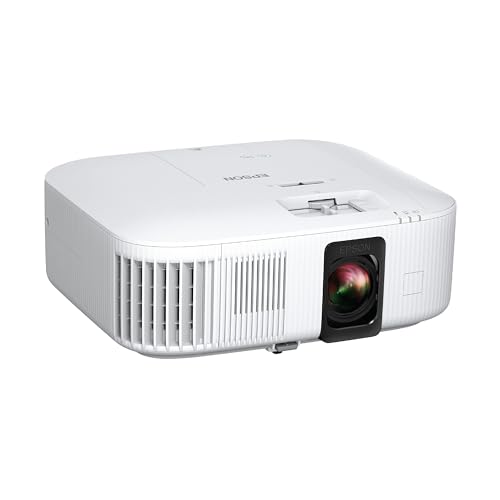
1. Epson Home Cinema 2350 — The Living-Room Pick for Most People
According to Epson, the Home Cinema 2350 is rated at 2,800 lumens of color brightness and 2,800 lumens of white brightness. Those are two different measurements, and the fact that the two figures match is why it ranks first: a projector with a high white number and a much lower color number can look dull in a lit room. Epson’s 3LCD design shows red, green and blue at the same time, which is why the colors hold up when you do not have blackout curtains.
The rest of the package is practical. Epson lists vertical lens shift, so you can move the picture without tilting the projector. It runs Android TV and supports HDR10 and HLG. Epson lists an input lag under 20 ms in low latency mode, which is fine for most console games, and a 10 W speaker, which most people will want to upgrade with a soundbar.
The trade-offs are clear. Epson’s 4K PRO-UHD is pixel shifting, not native 4K. It is lamp-based, with a replacement lamp sold as an accessory, so a lamp swap is part of ownership. Choose something else if you want native 4K, a laser source or a very short throw distance. Read the full breakdown in our Epson Home Cinema 2350 profile.
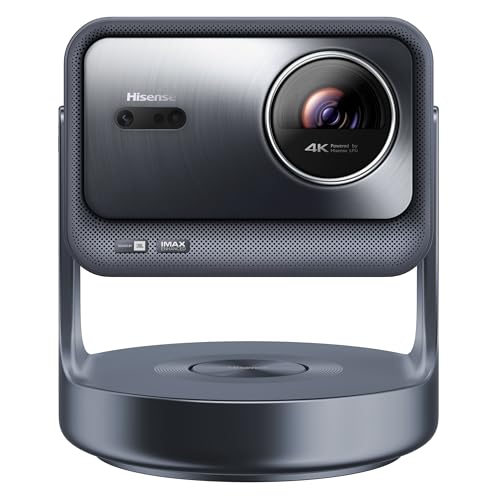
2. Hisense C2 Ultra — The Premium Projector You Can Aim Anywhere
The C2 Ultra is a compact triple-laser 4K projector on a built-in gimbal. Hisense says the gimbal swings 360 degrees horizontally and 135 degrees vertically, so you can aim at a wall one night and the ceiling the next without a mount. A 1.67x optical zoom keeps the image at 4K as you resize it, and Hisense says it adapts to screens from 65 to 300 inches. According to Hisense’s launch announcement, it delivers 3,000 ANSI lumens with a 2,000:1 contrast ratio and covers 110 percent of BT.2020.
It also has the most complete sound of the compact models, a JBL 2.1-channel system with a built-in subwoofer. Two caveats matter. It runs the VIDAA smart OS rather than Google TV, so check your apps first, and Hisense gives no throw ratio or input lag on the pages we opened. It is marketed as Designed for Xbox, but we cannot quote a latency number. It ranks second because few projectors are this easy to place, but it does not pair that flexibility with the safest platform. More in our Hisense C2 Ultra profile.
3. XGIMI Horizon S Pro — The Compact 4K for Movie Nights
XGIMI lists 4K resolution on a 0.47-inch DLP chip, Dual Light 2.0 and 1,800 ISO lumens. That is an ISO figure, so do not set it against Epson’s color brightness or an ANSI number from another brand. XGIMI also lists support for Dolby Vision, HDR10 and HLG, plus a 110 percent BT.2020 gamut that it says comes from its own laboratory.
The flexible built-in stand tilts up for ceiling projection, and XGIMI’s auto setup handles focus and keystone. Two 12 W Harman Kardon speakers make it one of the better-sounding small projectors, and it runs Android TV 11 with 32 GB of storage. The weak points are a single HDMI input and a 1.2:1 throw ratio, which puts the projector roughly 8.7 feet from the screen for a 100-inch picture, our calculation from the stated ratio. It ranks third because it is a polished 4K projector for dim rooms, but the Epson is easier to place and the Hisense is more flexible. See the XGIMI Horizon S Pro profile.
4. BenQ TK705STi — The Bright Short-Throw Pick for Small Rooms
BenQ lists 3,000 ANSI lumens, 4K UHD, a 0.8 throw ratio and a 4LED light source. With that ratio, a 100-inch picture needs the projector about 5.8 feet from the wall, by our calculation, so it fits on a coffee table in a room where a standard projector would have to sit behind the couch. It runs Google TV on Android 11 with Netflix, and BenQ lists HDMI 2.1.
It posts the lowest input lag figure in the group: BenQ lists 5 ms at 4K/60 Hz. It states only 60 Hz, so it is not a 120 Hz projector. BenQ’s page omits speaker, noise, weight and lens shift information, so plan on a soundbar and careful positioning. It uses digital keystone correction, which can soften the picture if you push it. It ranks fourth because it solves a specific problem very well. Details in our BenQ TK705STi profile.
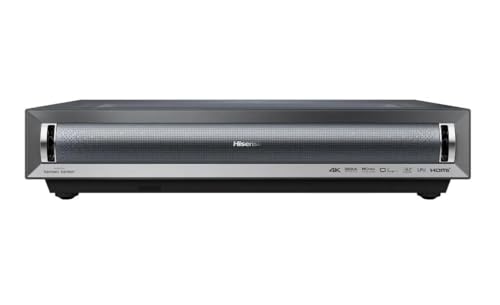
The PX3-PRO is an ultra short-throw projector. Hisense lists a 0.22 throw ratio, so the projector sits roughly 19 inches from the wall for a 100-inch picture, according to our calculation. It uses a triple laser with 3,000 ANSI lumens, supports Dolby Vision, HDR10+, HDR10, HLG and IMAX Enhanced, and runs Google TV. The 50 W Harman Kardon audio, Dolby Atmos support and two HDMI 2.1 ports make it a complete living-room unit.
Hisense sells it without a screen, and the picture gains a lot from an ambient light rejecting (ALR) screen, which reflects the light coming up from the projector toward you and rejects most light from lamps and windows. Without one, a 3,000:1 contrast ratio is modest. The projector is about 19.8 pounds and fixed in place. It ranks fifth because it asks the most of your room and budget, but if you want a TV replacement it is the strongest choice here. See the Hisense PX3-PRO profile.
6. Nebula Cosmos 4K SE — The Movable 4K for Living Room and Patio
Nebula lists 1,800 ANSI lumens from its HybridBeam source, which combines laser and LED, and a 4K resolution on a 0.47-inch DLP chip. Nebula does not say how that chip forms the 4K picture, so we do not call it native. It runs Google TV with official Netflix, has dual 15 W speakers, HDMI 2.1 with eARC and a Bluetooth speaker mode, and lists a 1.2:1 throw ratio and an image up to 200 inches.
It is portable only like a heavy desktop speaker, at 9.9 lb, and Nebula’s page says it has no built-in battery, so an outlet is required. That makes it a living-room projector that can visit the patio, not a camping device. It ranks sixth because its headline brightness is similar to the Horizon S Pro’s (though in ANSI rather than ISO lumens) and it offers fewer placement options. Read more in the Nebula Cosmos 4K SE profile.
Dangbei lists a native 1080p DLP chip, an ALPD laser rated at 30,000 hours and 1,200 ISO lumens. It is 1.87 inches thick and weighs 2.82 lb, so it fits on a shelf or nightstand. It runs Google TV with licensed Netflix and Chromecast built in, with autofocus and automatic keystone for setup.
It accepts a 4K signal but shows a 1080p picture, and its zoom is digital only, so the throw distance sets the picture size. Dangbei says it has no built-in battery, and its power adapter is 120 W, so a small USB power bank will not run it. It ranks seventh because convenience and a clean 1080p picture make it a good small-room choice, while the six models above it offer more brightness or flexibility. See the Dangbei Atom profile.
8. XGIMI MoGo 3 Pro — The Small, Light Pick for Dorms and Travel
XGIMI lists a 1080p DLP projector with an LED light source rated for 25,000 hours and 450 ISO lumens. It weighs about 2.4 lb (1.1 kg), runs Google TV with licensed Netflix and has two 5 W Harman Kardon speakers. The adjustable stand lets you tilt it up for ceiling viewing without drilling, which suits renters.
There is no built-in battery. XGIMI’s feature text recommends a 65 W Type-C power bank for extended use, and the optional PowerBase stand is another route. At 450 ISO lumens it needs a dark room, and its zoom is digital only. It ranks eighth because the brightness limits it to dark rooms. See the XGIMI MoGo 3 Pro profile.
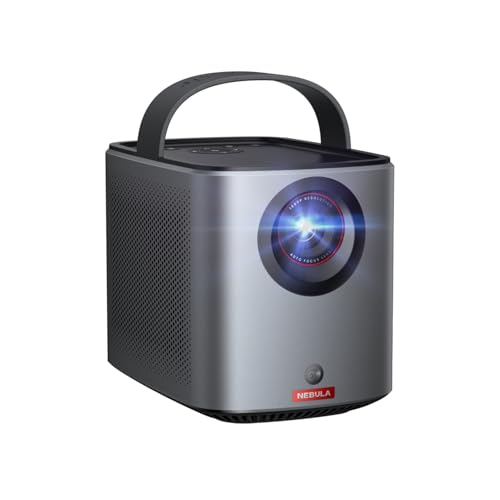
9. Nebula Mars 3 Air — The Backyard and Camping Projector with a Battery
Nebula lists a 1080p DLP projector with an RGB LED source and 400 ANSI lumens. The built-in battery is rated at 2.5 hours of movies in Eco Mode and up to 8 hours of music. Nebula says Eco Mode lowers brightness to save power, so a brighter setting runs for less time. It runs Android TV 11.0 with the Google TV interface and Netflix, with two 8 W speakers and a noise level under 28 dB.
At 400 lumens you need full darkness outdoors, so wait for the sky to go dark rather than starting at sunset. At 3.7 lb it is a carry-by-hand projector. Bring a charger for long films. Nebula lists no weather resistance rating, so treat it as an indoor or covered-patio device and bring it in when dew falls. It ranks ninth because its use case is narrower, but within that case it is a sensible choice. See the Nebula Mars 3 Air profile.
10. Nebula Capsule 3 — The Smallest Battery Projector
Nebula lists 1080p resolution, 200 ANSI lumens, an 8 W speaker, a weight of about 1.9 lb (0.85 kg) and dimensions of 3.1 by 3.1 by 6.3 inches (78 by 78 by 160 mm). It runs Android TV 11.0 with Google TV integration and licensed Netflix. Its battery is listed at 2.5 hours in Eco Mode, and charging uses a USB-C Power Delivery charger of 45 W or more.
At 200 lumens it is a dark-room device, and a 120-inch image would be dim and soft, so keep it to roughly 60 to 80 inches. It is small enough to carry in a backpack, which suits kids’ rooms, tents and travel. It ranks last because brightness is limited, not because it is poorly made. See the Nebula Capsule 3 profile.
Which Projector Should You Buy?
Here is the ranking again by use, in the same order.
Most Households: Epson Home Cinema 2350
Epson Home Cinema 2350
Matching color and white brightness, lens shift and Android TV make it the safe choice for a family room with some light.
The group falls into rough tiers. The Hisense C2 Ultra, Hisense PX3-PRO and XGIMI Horizon S Pro sit in the premium tier. The Epson Home Cinema 2350, BenQ TK705STi and Nebula Cosmos 4K SE are upper mid-range. The Dangbei Atom, XGIMI MoGo 3 Pro and Nebula Mars 3 Air are mid-range, and the Nebula Capsule 3 is entry-level to mid-range. Check the current price on Amazon, since it moves.
A Few Practical Tips
Measure your throw distance first. Our distances come from the makers’ throw ratios, multiplied by the image width, and a 100-inch 16:9 picture is about 87 inches wide.
Plan for darkness. Every projector looks better with the lights down. A model with 400 or fewer lumens needs a very dark room.
Plan the audio. Only a few of these have speakers that fill a living room. Bluetooth is for audio, not video.
Place it safely. Whether it sits on a shelf, a stand or a mount, make sure it is stable and the vents are clear.
Check the lamp. If you pick the Epson, a replacement lamp is a future cost.
Conclusion
The Epson Home Cinema 2350 is the best starting point for most households because it stays colorful in a lit room and is easy to position. The Hisense C2 Ultra is the flexible premium option, the XGIMI Horizon S Pro the compact 4K, and the BenQ TK705STi the short-throw answer. The Hisense PX3-PRO replaces a TV when paired with the right screen, and the Nebula Cosmos 4K SE is a bright all-rounder for a living room. For small spaces, choose the Dangbei Atom, XGIMI MoGo 3 Pro, Nebula Mars 3 Air or Nebula Capsule 3 according to whether you need a slim shape, a power bank, or a built-in battery.
We rank the Epson Home Cinema 2350 first. Epson rates it at 2,800 lumens for both color and white brightness, and it adds vertical lens shift, Android TV and an input lag under 20 ms. It is lamp-based and uses pixel-shifted 4K, so read those caveats first.
What is the difference between ANSI lumens, ISO lumens and color brightness?
They are different measurement methods, so numbers from different brands are not directly comparable. ANSI lumens average the light across a nine-point measurement pattern. ISO lumens follow a separate standard, and makers often quote a nominal value. Epson also publishes color brightness, which measures colors rather than white light only.
Is 4K on a projector always native 4K?
No. Epson says its 4K PRO-UHD shifts pixels to build the image, so it is not native 4K. Nebula lists a 0.47-inch DLP chip for the Cosmos 4K SE but does not say how it forms its 4K picture. At normal seating distances the difference is hard to see, but check the maker's wording.
Can I use a projector in a bright room?
Only a bright model helps, and even then expect washed-out blacks with open blinds. The 3,000 lumen models, such as the BenQ TK705STi and Hisense PX3-PRO, handle ambient light best. Pairing the ultra short-throw PX3-PRO with an ALR screen helps further. The small battery projectors are for dark rooms.
Do any of these projectors run on a battery?
Only the Nebula Mars 3 Air and Nebula Capsule 3 have built-in batteries, each rated at 2.5 hours in Eco Mode by Nebula. The XGIMI MoGo 3 Pro has no battery but runs from a USB-C power bank. The rest need a wall outlet.
Do I need a screen?
A smooth, light wall works for casual viewing. A screen gives better contrast, and the ultra short-throw Hisense PX3-PRO really needs an ALR screen to look its best. Hisense sells the projector without one.