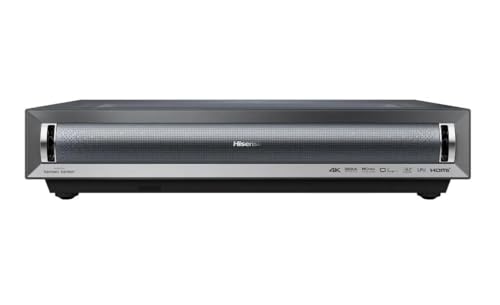
The Hisense PX3-PRO is not trying to be a projector in the traditional sense. It is a laser TV: a heavy, low box that sits on a console under the wall and throws an 80- to 150-inch picture from a short distance away. If a 65-inch TV looks small in your living room and you do not want a ceiling mount, wires across the room or a projector shining over your head, this is the category to look at.
This profile draws on the maker’s published specifications; where a figure is missing, we say so. Where it matters, we note which regional Hisense page we read.
Who the PX3-PRO Is For
It is for people who want a big picture with living-room convenience: a family room where the TV is the focal point, a game room with a big screen, or a basement home theater with a clean, wire-free look. It also suits buyers who care about picture quality and are ready to buy the right screen.
It is not for renters who move often, people who want to carry a projector to a friend’s house, or anyone who wants to spend as little as possible. This is a premium-tier product, and the unit is large.
Light Source and Brightness
According to Hisense, the PX3-PRO uses a red, green and blue trichroma laser light source, powered by what Hisense calls its LPU Digital Laser Engine, with a lifespan of 25,000 hours or more. Hisense says the laser shuts off automatically if someone gets too close, a useful safety feature when the projector sits at floor level.
Hisense lists 3,000 ANSI lumens and a 3,000:1 native and dynamic contrast ratio. ANSI lumens are an average of nine measurements across the image, so they are a more conservative figure than a peak claim, and they are not directly comparable to ISO lumens or to a maker’s own unit. Do not compare 3,000 ANSI lumens on a laser projector one-for-one with lamp or LED projectors rated by other methods.
A contrast ratio of 3,000:1 is modest. A projector cannot produce true black the way an OLED TV can, and in a bright room the black level rises further. That is why the screen matters.
Why a Screen Matters
Hisense sells the projector without a screen and lists ALR screens in 100- and 120-inch sizes. An ALR (ambient light rejecting) screen has an optical surface that reflects the light coming up from an ultra short-throw projector toward the viewing area and rejects most light from other directions, such as ceiling lights and windows. The result is deeper blacks and a more vivid picture with some light in the room.
On a plain white wall, the picture looks washed out in a lit room and much better in a dark one. If you plan to watch in daylight, budget for a good screen from the start, and make sure the wall or frame is flat. Ultra short-throw projectors are sensitive to wall imperfections because the light hits at a steep angle.
Resolution, HDR, and Color
Hisense lists a native 4K display. HDR formats are HDR10+, HDR10, Dolby Vision and HLG, and the projector is certified for IMAX Enhanced. The color gamut is listed as 110 percent of BT.2020 in one place and 107 percent in another on the same page, so treat it as roughly 107 to 110 percent, per Hisense. Motion smoothing (MEMC) is listed.
Placement and Throw Distance
The throw ratio is 0.22, according to Hisense. For a 100-inch 16:9 picture (about 87 inches wide), that puts the projector about 19 inches from the wall. A 120-inch picture needs about 23 inches, and a 150-inch picture about 29 inches. These are our own calculations from the stated ratio, and the depth of your cabinet matters, so check Hisense’s installation guide.
Hisense lists the unit at 21.7 inches wide, 4.8 inches tall and 11.7 inches deep, weighing 19.8 pounds. You need a sturdy, level console at least that wide, rated for the weight, with ventilation around it. If you have kids or pets, keep it out of reach, and keep the lens clean.
Hisense says the screen range is 80 to 150 inches. Because it is ultra short-throw, a small shift in position changes the image a lot, so take time to align it. It is not a projector to move from room to room.
Smart Features
The PX3-PRO runs Google TV with access to the Google Play Store, Google Assistant, Alexa compatibility, a built-in web browser and a voice remote, according to Hisense. Connectivity is Wi-Fi 6E and Bluetooth 5.3, with one LAN port. Hisense lists two HDMI 2.1 ports with ALLM, one HDMI 2.0 port, ARC, eARC on HDMI 3, and CEC support. USB connections are one USB 3.0 and one USB 2.0. No RF antenna input is listed, so you will rely on streaming, a streaming stick or a cable or satellite box.
Sound
Hisense lists 50 W of total output from front-firing Harman Kardon speakers, with Dolby Atmos and Dolby Digital. It is also WiSA ready, and has a headphone jack and an optical digital audio output. Fifty watts is far more than most projectors offer, and it is enough for casual viewing in a living room without a soundbar. For movie nights, many people will still add a soundbar or receiver, and eARC makes that straightforward.
Gaming
Hisense lists a Game Mode and ALLM on two HDMI 2.1 ports. The page we opened does not give refresh rate or input lag numbers. The Amazon listing title mentions a 240 Hz refresh rate and Designed for Xbox, so treat those as claims to confirm on Hisense’s spec sheet. With two HDMI 2.1 ports you can connect a console and a PC or streaming device without a switch.
Noise, Power and Ownership
Hisense does not give a noise level on the page we opened. A 250 W laser projector needs active cooling, so expect some fan noise; if you plan to use it in a quiet room, look into this before buying. Standby power is under 0.5 W. There is no lamp to replace, and the laser lifespan is listed at 25,000 hours or more. The pages we read did not state a warranty, so check the listing for current terms.
One more point: the specs above come from Hisense’s Canadian page. The US model may differ in details such as the exact port layout, so confirm against the current US spec sheet before buying.
Who Should Skip It
- Anyone who wants a portable or movable projector.
- Buyers who are not willing to budget for the right screen and a sturdy console.
- Shoppers who need confirmed gaming lag numbers from the maker.
- Anyone with a small room, where an 80-inch picture is plenty and a smaller projector will do.
Alternatives Among Our Picks
If you want a bright 4K projector and have a few feet of space in front of the screen, the BenQ TK705STi is a short-throw option that does not need a console against the wall. If you want something premium that can aim at walls and ceilings, consider the Hisense C2 Ultra.
Final Take
The Hisense PX3-PRO is the projector for people who want a TV replacement and are willing to plan for it. A 0.22 throw ratio, a triple laser, wide HDR support, 50 W Harman Kardon sound and two HDMI 2.1 ports make it a very complete package. The trade-offs are size, price tier and the need for a proper screen. Get those right, and it can transform a living room.
See price on Amazon
To see how it stacks up against the other nine models, read our ranking of the best projectors of 2026.
Sources