We earn a commission if you buy through our links, at no extra cost to you.
Best Projector for Camping and Backyard Movies
Battery vs power bank vs power station, when it gets dark enough, screens, wind, dew, campground quiet hours and which portable projectors suit camping.
At a glance
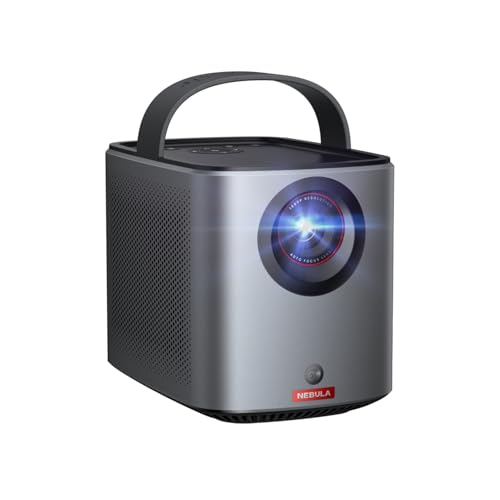
For camping, the Nebula Mars 3 Air has a built-in battery and a brighter 400 ANSI lumen picture, while the Nebula Capsule 3 is the smallest battery model for tents. The XGIMI MoGo 3 Pro has no battery but runs from a USB-C power bank. All three need real darkness.


A movie under the stars sounds simple until you try it. The picture washes out at dusk, the battery dies in the last half hour, the screen flaps in the wind and the campground next door has opinions about your volume. This guide walks through what actually matters for camping, RV trips and backyard movie nights: power, darkness, screens, weather and the rules, then matches three portable models from the site to three different setups.
This guide draws on the makers’ published specifications; where a figure is missing, we say so. None of these projectors has a published weather or water resistance rating, so treat all of them as dry-weather devices.
Power: Three Ways to Run a Projector Away From an Outlet
This is the first decision, because it shapes which projector you can buy.
Built-in battery. The simplest option. The Nebula Mars 3 Air and Nebula Capsule 3 both have one. Nebula lists about 2.5 hours of movies in Eco Mode for each, and up to 8 hours of music for the Mars 3 Air and up to 10 hours for the Capsule 3. Nebula’s support pages recommend Auto or Eco brightness to slow the drain. The honest limit is that 2.5 hours is shorter than many feature films. Plan on a charger or a power source for the end of a long movie.
USB-C power bank. Cheaper and lighter than a power station, but only some projectors can use one. XGIMI says to pair the MoGo 3 Pro with a Type-C 65 W power bank, and lists a USB-C port supporting PD 3.0. It has no internal battery. Nebula’s Capsule 3 lists a 45 W USB-C charger for charging its own battery. The Mars 3 Air lists a 19 V, 4.74 A input, roughly 90 W, and the Dangbei Atom ships with a 120 W adapter, so a small power bank will not run either of those. Check the output rating of any bank before you rely on it, because a projector can shut off if the supply drops.
Portable power station. A power station with an AC outlet runs almost anything, including the plug-in projectors. As rough arithmetic, not a promise: a 300 watt-hour station feeding a 65 W projector gives something like three to four hours after conversion losses. The real figure depends on the projector’s brightness mode and the station. Neither manufacturer publishes a runtime for external batteries, so we will not either.
Generators. National parks tend to restrict them, which we cover below, so a battery or a power station is the safer choice.
When Is It Dark Enough?
Brightness is the other half of camping. Battery projectors in this class are modest: the Nebula Mars 3 Air is rated at 400 ANSI lumens, the XGIMI MoGo 3 Pro at 450 ISO lumens, and Nebula’s pages report 200 ANSI lumens for the Capsule 3 in some versions. They are dusk-to-dark tools, not daylight machines, and ANSI and ISO lumens are measured differently, so do not treat those numbers as equal.
The National Weather Service defines three stages of twilight by how far the center of the sun sits below the horizon:
- Civil twilight ends when the sun is 6 degrees below the horizon. Bright stars and planets are visible and the horizon is distinguishable.
- Nautical twilight ends at 12 degrees. The horizon is still visible, but detailed outdoor work usually needs artificial light.
- Astronomical twilight ends at 18 degrees, when the sky is so faint that most observers consider it dark.
At sunset the sky is still bright. A projector with a few hundred lumens needs the sky to be dark, so waiting until the end of civil twilight is the minimum, and the end of nautical twilight is a safer plan. A site such as the National Weather Service or a sunrise-sunset table for your location gives twilight times. In midsummer at northern latitudes twilight lasts much longer, which pushes the start of the movie later than you expect.
Light from your own camp matters as much as the sky. Lanterns, string lights, headlights and a neighboring site’s campfire all raise the black level. Put the screen where light does not fall on it, and turn off nearby lights during the movie.
The Screen: Size, Material and Wind
You do not need a store-bought screen. A white bedsheet or a light gray tarp works if it is taut. Brightness drops as the picture grows, so a smaller picture is a brighter one. Nebula’s support pages give 40 to 120 inches as the working range for the Mars 3 Air and the Capsule 3, and Nebula’s FAQ recommends 5.2 to 8.7 feet from the screen for best results. At the 1.2:1 throw ratio listed for each of these models:
| Picture size | Lens distance at 1.2:1 |
|---|---|
| 40 inches | about 3.5 feet |
| 60 inches | about 5.2 feet |
| 80 inches | about 7 feet |
| 100 inches | about 8.7 feet |
That arithmetic is ours, from the stated ratio. For camping, 60 to 80 inches is the sweet spot: that size fits across a picnic table and keeps the picture bright.
Wind is the screen’s enemy. A sheet clipped to a clothesline flaps and wrinkles, which distorts the picture. Use a taut frame, a car or camper side wall, or the flat inside of a tent.
Dew, Dust and Weather
Nebula’s pages do not list a water or dust rating for either battery model, and XGIMI’s page for the MoGo 3 Pro lists none either. A few habits help:
- Do not set the projector on wet grass. Use a table, a camp stool or a tripod.
- Dew forms on cool nights, and condensation near the lens can fog the picture. Bring the projector inside when the movie ends.
- Keep the vents clear and out of direct sun during the day.
- A cooler or a camp box lid makes a good pedestal at the right height.
Sound and Campground Quiet Hours
Built-in speakers do not carry far outdoors, and wind takes sound with it. Nebula’s support pages say the built-in speaker shuts off when Bluetooth headphones or an external speaker connect, and describe a 3.5 mm AUX connection. Headphones are the courteous choice at a campground.
Most public campgrounds have quiet hours. Two National Park Service pages serve as examples. Great Smoky Mountains National Park says quiet hours run from 10 p.m. to 6 a.m., and prohibits generator use from 8 p.m. to 8 a.m. Yosemite says quiet hours run from 10 p.m. to 6 a.m., and allows generators only during three windows: 7 a.m. to 9 a.m., noon to 2 p.m. and 5 p.m. to 7 p.m. Other parks and campgrounds differ, so read the rules for the one you booked. The practical result: a movie that starts after dark often runs into quiet hours, and a generator is not a good answer.
Showing a Movie to a Group
Watching a movie with your family at your own site is one thing. Hosting a screening for a group is another. Swank Motion Pictures says a public performance is the exhibition of a movie that is shown outside of someone’s home, and that a license is required for all public performances regardless of whether admission is charged. Swank also says that neither the rental nor purchase of a movie carries the right to exhibit it outside of one’s home. If you run a movie night for a club, a campground or a neighborhood event, contact the licensor. If you are just watching with your own group at your own camp, read the campground’s rules as well.
Getting Content With No Signal
These projectors run Google TV, which needs Wi-Fi for streaming. At a remote campsite with no signal, Nebula’s support pages say a phone’s hotspot works as the network, and that the projector can play files from FAT32 or NTFS USB drives, up to 4 TB. Streaming services protect their content: Nebula says Netflix cannot be cast or mirrored, so use the Netflix app on the projector itself. Apps that support downloads may let you save a title for offline use, so check each service’s terms.
Which Portable Projector for Which Trip
For the whole lineup, see our 10-model projector comparison.
Nebula Mars 3 Air: Backyard and Car Camping
A handle, a built-in battery and a 400 ANSI lumen 1080p picture. A fit for backyard movie nights and car camping when you can plug in for the last half hour.
According to Nebula, the Mars 3 Air has 400 ANSI lumens, 1080p, two 8 W speakers, Google TV, built-in Netflix and 2.5 hours of movies in Eco Mode. It is the brighter of Nebula’s two battery models, so it is the better pick when you have a little ambient light. It weighs about 3.7 pounds. It does not run from a small power bank, so bring its charger and an outlet, an inverter or a power station for long films. Nebula lists no water resistance rating. See our Nebula Mars 3 Air profile.
Nebula Capsule 3: Tent and Backpack
A soda-can-size 1080p projector with a battery, Google TV and an 8 W speaker. A fit for a tent or a camper at night when you want the smallest load.
Nebula lists the Capsule 3 at about 1.9 pounds, 1080p, 2.5 hours of battery in Eco Mode and a noise level below 28 dB. It is the smallest battery model on the site, and a 40- to 80-inch picture inside a tent works well. The cost is brightness: our profile covers Nebula’s 200 ANSI lumen figure, which is dim, so it needs total darkness and a smaller picture. Do not plan on a big picture across a field. See the Nebula Capsule 3 profile.
XGIMI MoGo 3 Pro: When You Bring a Power Bank
A mini 1080p projector with no internal battery that runs from a USB-C power bank. A fit for long trips when you carry a 65 W bank or a power station.
XGIMI lists 450 ISO lumens, 1080p, Google TV with licensed Netflix, a 65 W power dissipation and a USB-C port that supports PD 3.0. XGIMI’s feature text says to pair it with a Type-C 65 W power bank. Because it has no battery of its own, the projector is only as good as your bank, and XGIMI does not publish a runtime for it. Its stand tilts up for a ceiling or tent roof. See the XGIMI MoGo 3 Pro profile.
Packing Checklist
- Projector and its charger, plus a spare cable
- A taut white sheet or screen and clips
- A table or tripod for the projector
- Bluetooth headphones or a small speaker
- A USB drive with files you are allowed to play, or a phone hotspot
- A power bank or power station rated for the projector’s input
- A towel for dew
Sources
Frequently asked questions
How long does a battery projector run?
Nebula lists about 2.5 hours of movies in Eco Mode for both the Mars 3 Air and the Capsule 3. Brighter settings should shorten that, and many feature films run past two and a half hours once you count the credits, so bring a charger or power source for the last stretch.
Can a power bank run a projector?
Only some. XGIMI says to pair the MoGo 3 Pro with a Type-C 65 W power bank, and lists a USB-C port supporting PD 3.0. Nebula's Capsule 3 page lists a 45 W USB-C Power Delivery charger for charging. The Mars 3 Air lists a 19 V, 4.74 A input, roughly 90 W, and Dangbei lists a 120 W adapter for the Atom, so a small power bank will not run those.
When is it dark enough to start a movie?
Civil twilight lasts until the sun is 6 degrees below the horizon, nautical twilight until 12 degrees and astronomical twilight until 18 degrees, according to the National Weather Service. For a projector with a few hundred lumens, wait until at least nautical twilight has ended, and later if there are lanterns or neighboring campsites nearby.
Can I stream Netflix at a campsite without cell service?
Not without an internet connection. Nebula's support pages say the projector needs Wi-Fi, that a phone hotspot works as the network, and that it plays video files from FAT32 or NTFS USB drives. Plan to load files you are allowed to play onto a drive before you leave.
Are campground quiet hours a problem?
They can be. Great Smoky Mountains National Park says quiet hours run from 10 p.m. to 6 a.m., and Yosemite says the same. Use headphones or keep the volume low, and check the rules for your specific campground.
Do I need a license to show a movie to a group at a campground?
Swank Motion Pictures says that showing a movie outside someone's home is a public performance that needs a license, and that owning or renting a copy does not carry that right. A private family movie at your own site is a different matter, but check the rules of the campground and the licensor if you are hosting a group.